
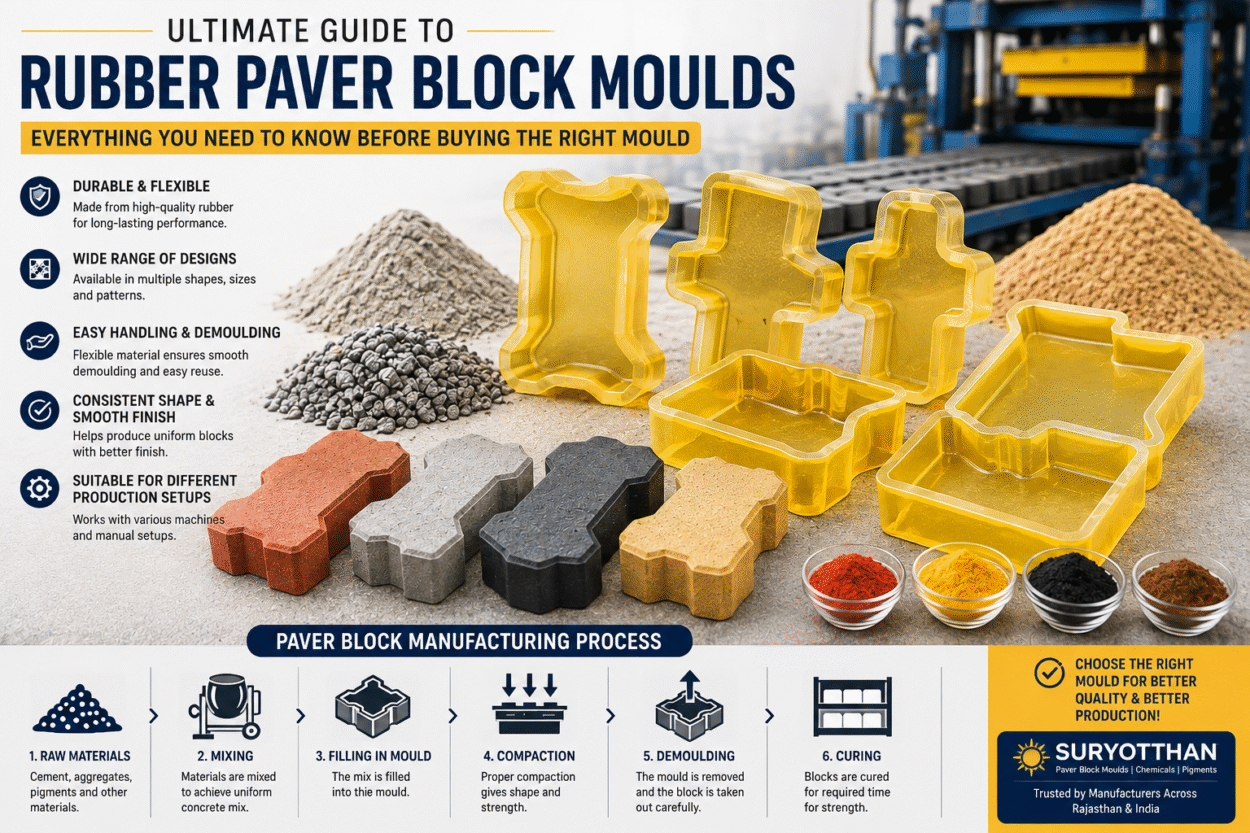
When you manufacture paver blocks every part of the production process matters.
Cement and aggregates are important. Mixing is important. Curing is important.
But there is one more thing that directly gives your paver block its shape and design: the mould.
For a manufacturer the mould is not simply a tool. It is part of the production process. The right mould can help you produce the required design and make the moulding and demoulding process easier.
But choosing a mould only because the design looks good is not always the right approach.
You also need to consider the mould quality, flexibility, design, production setup and your actual manufacturing requirement.
In this guide we will explain rubber paver block moulds in simple language so you can make a better buying decision.
What Is a Rubber Paver Block Mould?
A rubber paver block mould is used to form concrete material into a particular paver block shape and design.
During production the required concrete mixture is placed into the mould. The mixture is then compacted according to the production process. Once the block has been formed the mould is removed and the block moves to the next stage.
The mould therefore plays an important role in determining the shape, pattern and surface appearance of the finished paver block.
Rubber moulds are available in different designs and sizes.
This gives manufacturers the flexibility to choose a mould according to the type of paver block they want to produce.
Why Is the Right Paver Block Mould Important?
Think about making the same roti at home.
The ingredients may remain the same but if you use different cutters or shapes the final product will look different.
Paver block moulds work in a similar way.
The mould gives the concrete mixture its final shape and pattern.
A suitable mould can help manufacturers achieve the required:
- Block design
- Shape
- Pattern
- Surface appearance
- Dimensions
- Production requirements
This is why mould selection should be treated as a production decision rather than only a design decision. A mould that looks attractive may not necessarily be suitable for your particular production setup
What Are the Benefits of Rubber Paver Block Moulds?
Flexible Material
Rubber is flexible. This can make handling and demoulding easier compared with some rigid mould options.
The actual result will still depend on the mould design and the manufacturing process being used.
1. Aggregates
Aggregates form a major part of the concrete mixture. Their size, quality and proportion can influence the final block. Clean and suitable aggregates are important for consistent production.
2. Different Design Options
Rubber paver block moulds are available in different patterns.
Manufacturers can select designs according to their product range and customer requirements.
3. Suitable for Different Paver Block Designs
A manufacturer may produce simple paving blocks for one customer and decorative designs for another. Having different mould designs can help manufacturers offer more product options
4. Easy Handling
The flexibility of rubber can make the mould easier to handle during the production process.
However manufacturers should always follow the recommended handling method for the specific mould.
What Should You Check Before Buying a Rubber Paver Block Mould?
Before purchasing a mould it is better to check a few important points.
1. Mould Design
First decide what type of paver block you want to manufacture.
Do you need:
- Zig Zag
- I Shape
- Damru
- Cosmic
- Tortoise
- Rectangle
- Square
- Hexagon
- Grass Paver
- Parking Tile
- Kerb Stone
The design should match the product you want to sell.
Don’t choose a mould only because another manufacturer is using it.
Your customer demand may be different.
2. Mould Quality
Mould quality is another important factor.
The mould is used repeatedly during production so you should understand its construction and suitability before purchasing.
Don’t compare suppliers only on price.
A very low-priced product may not provide the value you expect if it does not suit your production requirements.
Ask the supplier about:
- Mould specifications
- Material
- Design
- Handling
- Usage
- Availability
A supplier who clearly explains the product can make the buying decision easier.ture.
3. Flexibility
Rubber moulds are flexible by nature.
This flexibility can be useful when handling and removing the mould from the formed block.
However flexibility alone should not be the only buying factor. The mould should also be suitable for the production method and block design you are using.
4. Production Method
Your production setup matters.
Before buying a mould consider:
- How you manufacture the paver blocks
- Which machine or setup you use
- Your production volume
- The block design
- Your handling process
A mould should be suitable for your actual manufacturing process. If you are unsure then discuss your setup with the supplier before placing an order
5. Mould Size and Specifications
Don’t forget to check the specifications.
The mould should match the size and design of the paver block you want to produce.
Before ordering confirm:
Design → Dimensions → Specifications → Production suitability
This simple check can help avoid ordering the wrong mould.
Common Mistakes Manufacturers Make When Choosing Moulds
Many manufacturers focus heavily on the design and price.
But there are other things that matter too.
Mistake 1: Choosing only by price
The cheapest mould is not automatically the best mould.
Consider quality and suitability along with price.
Mistake 2: Choosing only by appearance
A design may look attractive but may not match your customer’s requirement.
Mistake 3: Not checking specifications
Always confirm the mould dimensions and design before ordering
Mistake 4: Not discussing production requirements
Tell your supplier what type of paver block you manufacture.
This allows the supplier to understand your requirement better.
Mistake 5: Ignoring handling
Ask how the mould should be handled, stored and used.
Proper handling can help maintain the mould during regular production.
Different Rubber Paver Block Mould Designs
Every paver block manufacturer may have different customer requirements.
Some may focus on standard interlocking blocks. Others may manufacture decorative pavers, parking tiles or grass pavers.
Suryotthan offers different rubber paver block mould designs for manufacturers.
These include:
- Zig Zag
- I Shape
- Damru
- Cosmic
- Tortoise
- Rectangle
- Square
- Hexagon
- Uni
- Wave
- Holland
- Behaton
- Brick Design
- Cobble Stone
- Grass Paver
- Parking Tile
- Kerb Stone
The availability of designs can depend on the current product range.
If you need a particular design it is always better to confirm availability and specifications before ordering.
How to Choose the Right Rubber Paver Block Mould
Not sure which mould to choose?
Use this simple process.
Step 1: Identify Your Product
First decide what type of paver block you want to manufacture.
Step 2: Understand Your Customer
What designs are your customers asking for?
If you mainly supply residential projects your requirement may be different from a manufacturer supplying commercial or parking projects.
Step 3: Check Your Production Setup
Consider your machine, production process and expected production volume.
Step 4: Compare Mould Options
Compare the available designs and specifications.
Don’t compare only prices.
Step 5: Ask the Supplier Questions
Ask about:
- Design
- Dimensions
- Material
- Handling
- Availability
- Suitable production method
Step 6: Confirm Before Ordering
Before placing the order make sure the selected mould matches your actual requirement.
This small step can save time and avoid unnecessary problems later.
Rubber Paver Block Moulds From Suryotthan
Suryotthan Merchandise Pvt. Ltd. manufactures and supplies rubber paver block moulds for paver block manufacturers.
Our mould range includes different designs for different production requirements.
Along with rubber paver block moulds we also manufacture and supply:
- Paver Block Chemicals
- Imported Iron Oxide Pigments
This gives paver block manufacturers access to multiple production-related products from one supplier.
Our focus is on understanding the manufacturer’s requirement and helping them choose a suitable product.
If you already know the mould design you need you can share the design with our team. If you are unsure about the right option you can discuss your production requirement with us first
Why Manufacturers Choose Suryotthan
For a B2B manufacturer the relationship with a supplier is not only about buying a product.
You also need clear information and reliable communication.
At Suryotthan we focus on:
Product Variety
Different rubber paver block mould designs for different requirements.
B2B Understanding
We understand that manufacturers need products according to their production requirements.
Multiple Product Categories
Rubber paver block moulds, paver block chemicals and imported iron oxide pigments.
Rajasthan Focus
We focus strongly on serving paver block manufacturers across Rajasthan.
India Supply
Our products can also be supplied to manufacturers across India.
Conclusion
Choosing a rubber paver block mould is not simply about selecting a design.
You should consider quality, flexibility, specifications, production method, customer requirements and supplier reliability.
The right mould should fit your production process and the type of paver blocks you want to manufacture.
Before placing an order take a few minutes to understand your requirement and discuss it with the supplier.
That simple step can make the buying process much easier.
Looking for Rubber Paver Block Moulds?
Suryotthan supplies rubber paver block moulds in different designs for paver block manufacturers across Rajasthan and India.